

Bold, unapologetic coverage of the game behind the game—investigations, analysis, money, and culture. No spin. No fluff. Just receipts.
Latest Articles
Investigations, betting breakdowns, and the pulse of Las Vegas sports.
Explore Categories
Inevitable Impact: Why Jayden Daniels’ Injury Was Always Coming
LVSM breaks down how Washington’s risk management failed its franchise QB — and why this injury was inevitable.
Read FeatureLatest Stories
In-depth features and investigative pieces from Las Vegas Sports Media.
Inevitable Impact: Why Jayden Daniels’ Injury Was Always Coming
How frame, style, and culture made his injury a matter of when — not if.
Read MoreHidden Flags: The Unseen Injuries That Define the Game
Inside the quiet pain shaping football’s biggest performances — and the data teams ignore.
Read MoreStay Ahead of the Game
Join LVSM for investigative drops, odds intel, and cultural coverage that hits harder.
Join the Movement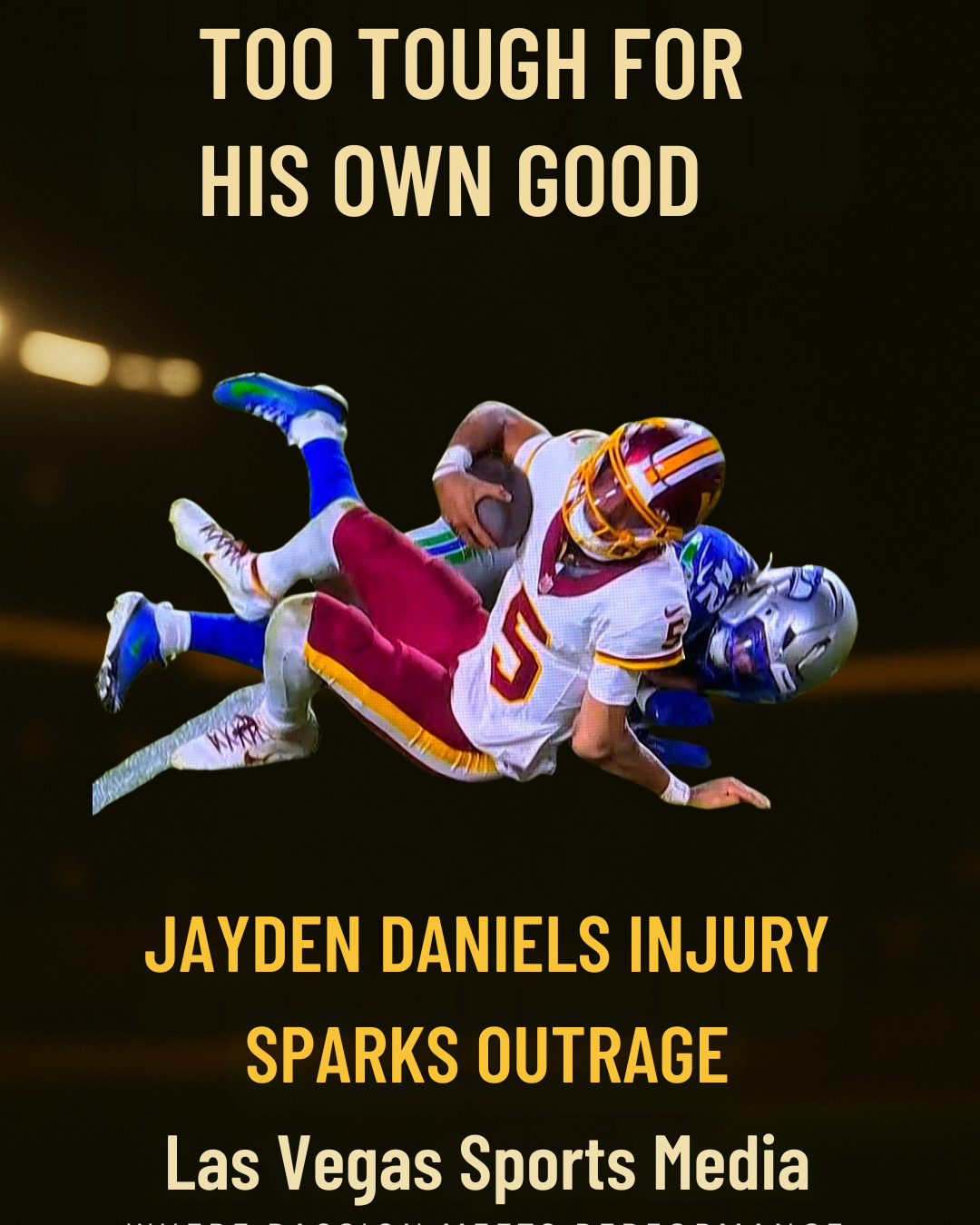
Inevitable Impact: Why Jayden Daniels’ Injury Was Always Coming
Rookie QB Jayden Daniels’ dislocated elbow wasn’t bad luck — it was inevitable. Las Vegas Sports Media breaks down how his frame, style, and Washington’s culture made this injury predictable.
Inevitable Impact: Why Jayden Daniels’ Injury Was Always Coming

Introduction
It was a night that felt like the season slipping away. With the Washington Commanders trailing the Seattle Seahawks 38–7 and 7 minutes and 39 seconds left in the fourth quarter, rookie quarterback Jayden Daniels—already nursing a hamstring strain and a lingering knee issue—was still under center.
Then came the hit.
On what would be his 10th rushing attempt of the game, Daniels rolled out of the pocket, trying to escape pressure and extend a meaningless play in a game long decided. As he sprinted upfield, he was tackled from behind. Falling forward, Daniels instinctively reached out to brace himself—but instead of landing safely, he planted his left arm, and his elbow snapped violently on impact.
The diagnosis: a dislocated left elbow.
For a team that entered the game 3–5, still clinging to fading playoff hopes, the loss was already brutal. But this moment could prove catastrophic—not just for the season, but for the future of the franchise.
If Daniels had used his right arm, his throwing arm, to break that fall, the Commanders wouldn’t just be dealing with a painful injury. They’d be facing the possibility of losing their franchise quarterback’s entire career before it ever truly began.
After the game, head coach Dan Quinn didn’t deflect or soften the blow. “That’s 100 percent on me,” Quinn admitted postgame, taking responsibility for leaving Daniels in a game that was long over. It was accountability—but also an indictment. In that moment, the Commanders gambled with their future, and the cost may be far greater than the scoreboard could ever show.
The Situation: Down 30, 7 Minutes Left, and Still In
By the time Jayden Daniels lined up for what became the play of the night—and possibly the turning point of Washington’s season—the scoreboard already told the story: Seattle 38, Washington 7. The game wasn’t just out of reach; it was gone. Most teams, at that stage, would have pulled their starter, especially a second-year quarterback already dealing with two lower-body injuries and enduring relentless pressure all night.
But Washington didn’t. Daniels was still taking snaps, still absorbing hits, still trying to manufacture life in a game that was already lifeless. It was the definition of “garbage-time football,” the stretch when smart franchises start thinking about health and tomorrow instead of pride and optics.
For context, Daniels had been hit or hurried on over 40 percent of his drop-backs that evening, according to Pro Football Focus. The Commanders’ offensive line—thin and overmatched—had struggled all game to contain Seattle’s front seven. Each series became a gamble with their franchise cornerstone.
Why was he still in? That’s the question echoing through D.C. talk shows and national panels. The Commanders were sitting at 3-5 entering the night, a team fighting for mathematical playoff survival, not moral victories. A loss would push them to 3-6, near the bottom of the NFC East and outside every postseason projection. Keeping Daniels on the field wasn’t going to change that equation—but it could change everything else.
And it did.
The decision to let him keep running plays in a 31-point blowout didn’t just look bad in hindsight; it was reckless in real time. Coaches often talk about “finishing the fight,” but this wasn’t a fight—it was a beating. The only thing left to protect was the future, and that’s exactly what Washington risked.
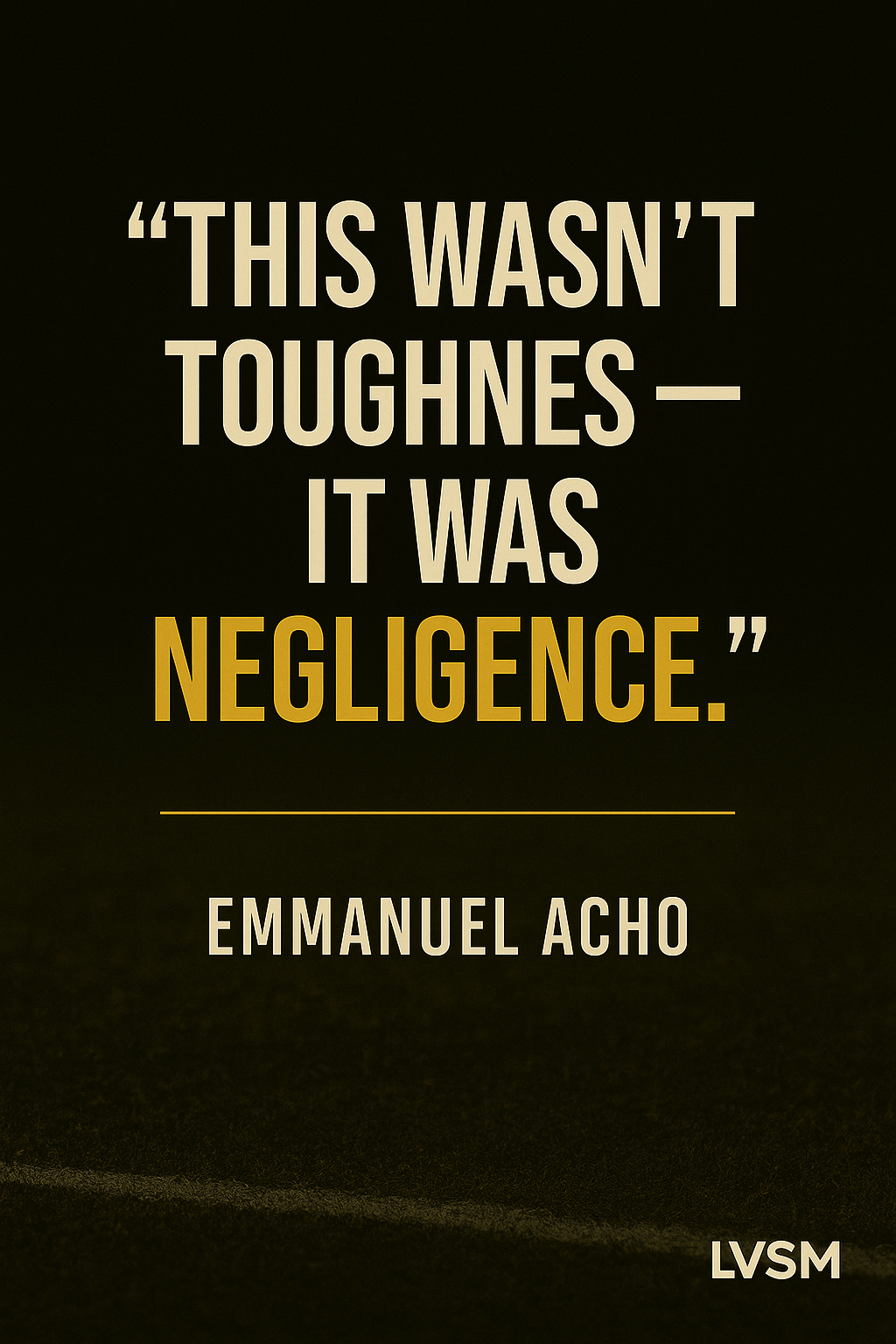
So when Daniels hit the turf, his arm twisting grotesquely beneath him, it wasn’t simply bad luck. It was the predictable outcome of a team that refused to recognize the difference between competitive toughness and organizational negligence.
Daniels’ Frame, Style & Injury Risk
Let’s say the quiet part out loud: Jayden Daniels is long, light, and electric—built more like a track athlete than a bulldozer. At ~6'5 and ~210 lbs, he plays a collision position with a glider’s body. That doesn’t make him soft; it makes him physics-exposed. When you combine a slender frame with a high scramble/keeper rate, plus NFL-level pursuit speed, you get a risk profile that punishes even tiny mistakes in leverage—like bracing a fall with the wrong arm at the wrong angle.
This isn’t about courage. Daniels has that in spades. It’s about force distribution and contact frequency:
- Force distribution: Lighter frames transfer more impact to narrower joints on awkward landings (elbows/wrists/shoulders), especially when bracing falls.
- Contact frequency: Dual-threat QBs take extra “open-field” hits beyond pocket sacks—often with less bracing and more rotational torque.
- Injury compounding: Prior lower-body issues (hamstring/knee) can subtly change mechanics, raising the chance of catching bad angles when hit or when falling.
Six-Year pattern (college → NFL): Hamstring and knee flags pop up multiple times in Daniels’ timeline (college through the pros), and now an elbow dislocation. That pattern fits the classic dual-threat risk curve: lower-body soft-tissue early, upper-body trauma after repeated scramble exposure.
The takeaway: Style + frame + usage is the triad. If Washington won’t change the usage (hit volume), they must compensate with faster decisions, more quick-game throws, slide rules, sideline throwaways, and hard “no-hit” coaching in garbage time.

LVSM Injury Projection Model (v0.1)
Goal: Give readers, coaches, and GMs a usable lens to compare quarterbacks with different builds and play styles—no hype, just signal. This is a first version, built on biomechanics common sense and public bio metrics; we’ll tighten with game-charting data (rush attempts, scramble rates, sack rates, injury logs) as we expand.
Inputs (per QB)
- Body Load (BL): inverse of mass density for height (lighter for height = higher BL).
- Contact Load (CL): designed runs + scrambles per game, plus sack rate proxy.
- Prior Injury Burden (PIB): weighted count last 3 years (recent = heavier weight).
- Age Factor (AF): >28 adds mild risk; >32 adds more (recovery/elasticity).
- Play-Style Multiplier (PSM): pocket (1.0), mixed (1.1), dual-threat (1.2–1.35).
Composite (scaled 0–1.5, higher = more exposure)
IEI (Injury Exposure Index) = 0.30·BL + 0.30·CL + 0.20·PIB + 0.10·AF + 0.10·PSM
Rule of Thumb (v0.1):
IEI ≤ 0.60 = lower exposure, 0.61–0.95 = moderate, ≥ 0.96 = high.
“Healthy Seasons Remaining” (illustrative)
HSR ≈ 5.0 − 3.0·IEI (floor at 0.5)
Not a medical prognosis—an editorial guide to risk tiers.
Quick Compare — Body/Style Archetypes (illustrative tiers)
| Quarterback | Height / Weight | Archetype | Snapshot of Injury Notes* | IEI Tier (v0.1) | HSR Guide |
|---|---|---|---|---|---|
| Jayden Daniels | ~6'5 / ~210 | Dual-threat (high scramble) | Multiple lower-body flags (hamstring/knee) + elbow dislocation | High | ~1–2.5 |
| Jalen Hurts | ~6'1 / ~225 | Power dual-threat (designed runs, short-yardage) | Ankle/shoulder episodes; high red-zone contact | Med-High | ~2–3.5 |
| Lamar Jackson | ~6'2 / ~212 | Elite dual-threat (open-field) | Lower-body (ankle/knee) stretches, load managed lately | Med-High | ~2–3.5 |
| Daniel Jones | ~6'5 / ~230 | Dual-threat (scramble usage) | Neck/ACL history, pocket hits + runs | High | ~1–2.5 |
| Baker Mayfield | ~6'1 / ~215 | Pocket/mixed (limited QB run game) | Shoulder (past), otherwise workable | Medium | ~3–4 |
| Jared Goff | ~6'4 / ~217 | Pocket (quick-game) | Generally durable, low designed runs | Low-Med | ~3.5–4.5 |
| Joe Flacco | ~6'6 / ~245 | Traditional pocket | Major past knee, aging factor, but minimal run exposure | Medium (age-weighted) | ~1–2 |
| Sam Darnold | ~6'3 / ~225 | Pocket/mixed | Shoulder/ankle, earlier mono; usage varies by scheme | Medium | ~2.5–3.5 |
*Injury summaries are high-level, editorial snapshots; we’ll tighten with date-stamped logs in the v0.2 dataset.
What this says about Daniels (and Washington)
- BL: Tall + light = higher BL.
- CL: Top-tier scramble/keeper exposure—spikes IEI.
- PIB: Soft-tissue stack (hamstring/knee) now paired with upper-extremity trauma (elbow).
- PSM: True dual-threat.
- Result: IEI: High unless Washington materially reduces designed QB runs in low-leverage game states, speeds the ball out (RPO/quick game), and enforces “no-hit” rules late.
Coaching levers that move the number (immediately)
- Kill designed QB runs when trailing by 14+ in Q4.
- Slide/Out-of-Bounds mandate on scrambles past the sticks.
- Sacks to zero mindset: hot reads, quick-game plan vs edge heat.
- Personnel tells: heavier 12-personnel to protect edges on obvious pass.
- Garbage-time policy: backup QB finishes drives down 20+ after mid-Q4.
The Numbers Don’t Lie
The tape tells one story. The numbers tell another. Together, they reveal a pattern the Commanders can’t afford to ignore.
When Jayden Daniels went down in Seattle, it wasn’t a fluke; it was math meeting inevitability. According to Pro Football Focus (2022), quarterbacks are 25 percent more likely to suffer severe injuries during fourth-quarter blowouts when trailing by 20 points or more. It’s the danger zone for any offense still trying to prove a point instead of protecting its people.
In those moments, defenses pin their ears back, backups hunt reps, and quarterbacks—especially mobile ones—become target practice for desperation. It’s not toughness; it’s exposure.
Now, pair that league-wide data with the LVSM Injury Projection Model (v0.1) we introduced above, and the picture gets even clearer. That model combines a quarterback’s body load (frame vs. height), contact frequency (rushes + sacks), and injury burden to forecast his “healthy seasons remaining.” It’s not science fiction—it’s a smarter way to measure risk tolerance for a franchise’s most important asset.
Here’s where Daniels stands:
- Body Load: One of the lightest builds among starting QBs at 6'5" / 210 lbs.
- Contact Load: Entering Week 9, Daniels had 10 rush attempts in this game alone and averaged 7.4 rushes per game—top 3 among all quarterbacks.
- Injury Burden: Hamstring and knee issues before this elbow dislocation mark a pattern of high-frequency, lower-body stress followed by upper-body trauma.
Plug those variables into the LVSM model, and Daniels grades as a High Exposure QB, projecting just 1 to 2.5 healthy seasons at his current usage rate unless the Commanders significantly reduce his designed-run and scramble load.
By contrast:
- Jared Goff and Baker Mayfield, both heavier pocket passers, land in the Low–Medium risk range, projecting 3.5–4.5 healthy seasons.
- Jalen Hurts and Lamar Jackson, sturdier dual-threats with more managed rushing volume, fall in the Medium–High zone, roughly 2–3.5 seasons.
Daniels, despite his youth and resilience, is already operating on the far end of that spectrum—and that should terrify Washington. Because here’s the bottom line: you can coach decision-making, you can build protection, but you can’t out-coach physics. If Washington keeps treating Daniels like a crash-dummy in blowout minutes, the analytics—and the history—say it’s not a matter of if he gets hurt again. It’s when. The numbers don’t lie. They never have. It’s the teams that ignore them that usually pay the price.

Washington’s History of Mismanagement
When Jayden Daniels went down in Seattle, you could almost hear the collective flashback across D.C. sports bars: Robert Griffin III, 2012. Different year, different coach, same story.
Washington has a history of building its hopes around young, dynamic Black quarterbacks—then watching those hopes crumble under the weight of poor protection, reckless decisions, and outdated ideas about “toughness.”
The RG3 Parallel
In 2012, Griffin’s rookie season felt revolutionary. He was the future: electric, fearless, and fast. But when he tore his ACL and LCL in the wild-card game against Seattle—the same franchise that would injure Daniels more than a decade later—it wasn’t just a knee snapping; it was the beginning of Washington’s long-term credibility problem.
The franchise was warned that Griffin was hurt. He said he could play, and the team let him. The result? Three surgeries, a lost step, and a career that never fully recovered.
Fast-forward to 2025, and it’s déjà vu. Daniels, only in his second season, is carrying the same combination of explosive athleticism and dangerous vulnerability. His elbow injury isn’t identical to RG3’s knee blowout, but the story around it feels familiar: a coaching staff that talks grit when it should be talking guardrails.
Patterns That Can’t Be Ignored
- Overexposure in meaningless minutes
– RG3 in a playoff game he should’ve exited early.
– Daniels in a blowout, seven minutes left, still taking hits. - Failure to prioritize preservation over pride
– In both cases, Washington blurred the line between leadership and negligence. - Cultural bias beneath the decisions
– The belief that Black quarterbacks must constantly prove their toughness, that they can take more pain, that durability equals legitimacy.
– It’s a mindset rooted less in football strategy and more in cultural stereotype—one that has quietly cost the league countless careers.
Academic studies back this up. Sports Medicine Clinics (2023) found that athletic trainers often rate Black athletes as having higher pain tolerance, affecting return-to-play timelines. A PLOS ONE review showed similar bias in NFL injury reporting, and a Harvard Medical School study confirmed that Black former NFL players experience worse chronic pain later in life despite being labeled “tougher” in their playing days.
Negligence Has a Pattern Here
From Griffin to Dwayne Haskins to now Daniels, the Commanders’ quarterback carousel has been haunted by a common thread—young, talented Black quarterbacks asked to carry too much, too soon, for an organization that hasn’t learned how to protect them.
And when protection fails, the same phrases surface every time: “He’s a warrior.” “He wanted to be out there.” “That’s on me.”
Accountability after the fact doesn’t reverse impact injuries. It doesn’t repair ligaments or restore nerve endings. It only highlights how preventable these moments truly are.
History Doesn’t Repeat — It Echoes
Jayden Daniels didn’t need to be a hero on a 38-7 scoreboard. He needed to be the future. But history in Washington keeps replaying like a bad film reel, only with different jerseys and updated logos. Until the Commanders break that cycle—until they learn that protecting their quarterback isn’t weakness but wisdom—they’ll keep losing more than games. They’ll keep losing generations of talent.
Lessons That Still Haven’t Been Learned
The Washington Commanders didn’t just lose a game in Seattle—they lost sight of the bigger picture. Again.
Every franchise preaches about toughness. Every coach talks about accountability. But only a few seem to understand that true toughness isn’t about staying on the field when the battle is lost; it’s about protecting your people so they can fight another day.
That lesson has come wrapped in pain for Washington over the years. From Robert Griffin III’s knee, to Dwayne Haskins’ burnout, to Jayden Daniels’ elbow, this organization has repeatedly treated survival as a substitute for strategy.
What we’re seeing isn’t just poor coaching—it’s poor culture. A culture that confuses grit with recklessness. A culture that glorifies pain tolerance instead of game intelligence. A culture that looks at its young Black quarterbacks and tells them, “Prove it again.”
And while coaches like Dan Quinn may stand at the podium and say “That’s on me,” the real responsibility runs deeper—into the front office, the training staff, and the systemic mindset that still prioritizes optics over longevity.
Because the truth is simple: franchise quarterbacks aren’t expendable—they’re irreplaceable. You don’t gamble them away for “message-sending” drives in meaningless minutes. You protect them, you build around them, and you teach them that walking off the field healthy is not weakness—it’s wisdom.
Jayden Daniels’ injury should be a wake-up call. Not just for Washington, but for every team that treats their dual-threat quarterback like a highlight reel instead of a long-term investment. The LVSM Injury Projection Model showed exactly what the tape has been screaming for years: you can’t ignore body load, hit volume, and injury history and expect durability to magically hold.
Daniels might recover. He might even come back stronger—because his talent, leadership, and competitiveness are unquestioned. But recovery doesn’t erase negligence. It only delays the next test of whether this organization has finally learned anything at all.
And if they haven’t? The next injury won’t just cost a game or a season. It’ll cost another future.
Takeaway / Epilogue — “The Price of Not Learning”
Jayden Daniels’ elbow injury wasn’t a mirror — it was a warning fulfilled. The kind everyone could see coming if they were paying attention.
From the moment Washington drafted him, you could tell: the kid was electric, confident, fearless — and thin. That’s not a knock on his talent; it’s an observation rooted in the reality of the league he stepped into. At 6'5" and roughly 210 pounds, Daniels doesn’t look fragile — but compared to the men trying to bring him down, he’s giving up 30 to 60 pounds of pure muscle on almost every hit. That’s not sustainable when your style of play invites contact.
This was always the concern. The same legs that make him special also make him exposed. And when you combine that kind of frame with a style built on tucking the ball, sprinting into traffic, and trying to out-run edge rushers who weigh as much as linemen — the outcome isn’t poetic. It’s predictable.
This isn’t about toughness, and it’s not about coaching alone. It’s about physics, preparation, and body composition. You can’t consistently run into 250-pound linebackers and 280-pound defensive ends without building the body to take those hits. Eventually, something gives — and this time, it was Daniels’ elbow.
He didn’t get hurt because he’s reckless. He got hurt because his frame and play style collided with NFL reality. And until that changes — until he adds size, muscle, and protection to match his fearlessness — this won’t be the last time he takes a hit that changes everything.
For Washington, this wasn’t bad luck. It was bad odds. For Daniels, it’s not a career-defining tragedy — it’s a physical reckoning. If he can adjust, evolve, and build the body his game demands, he’ll be fine. Maybe even great. But if not, this league will keep teaching the same brutal lesson: Talent gets you drafted. Durability keeps you here.
