

Bold, unapologetic coverage of the game behind the game—investigations, analysis, money, and culture. No spin. No fluff. Just receipts.
Latest Articles
Investigations, betting breakdowns, and the pulse of Las Vegas sports.
Explore Categories
Inevitable Impact: Why Jayden Daniels’ Injury Was Always Coming
LVSM breaks down how Washington’s risk management failed its franchise QB — and why this injury was inevitable.
Read FeatureLatest Stories
In-depth features and investigative pieces from Las Vegas Sports Media.
Inevitable Impact: Why Jayden Daniels’ Injury Was Always Coming
How frame, style, and culture made his injury a matter of when — not if.
Read MoreHidden Flags: The Unseen Injuries That Define the Game
Inside the quiet pain shaping football’s biggest performances — and the data teams ignore.
Read MoreStay Ahead of the Game
Join LVSM for investigative drops, odds intel, and cultural coverage that hits harder.
Join the Movement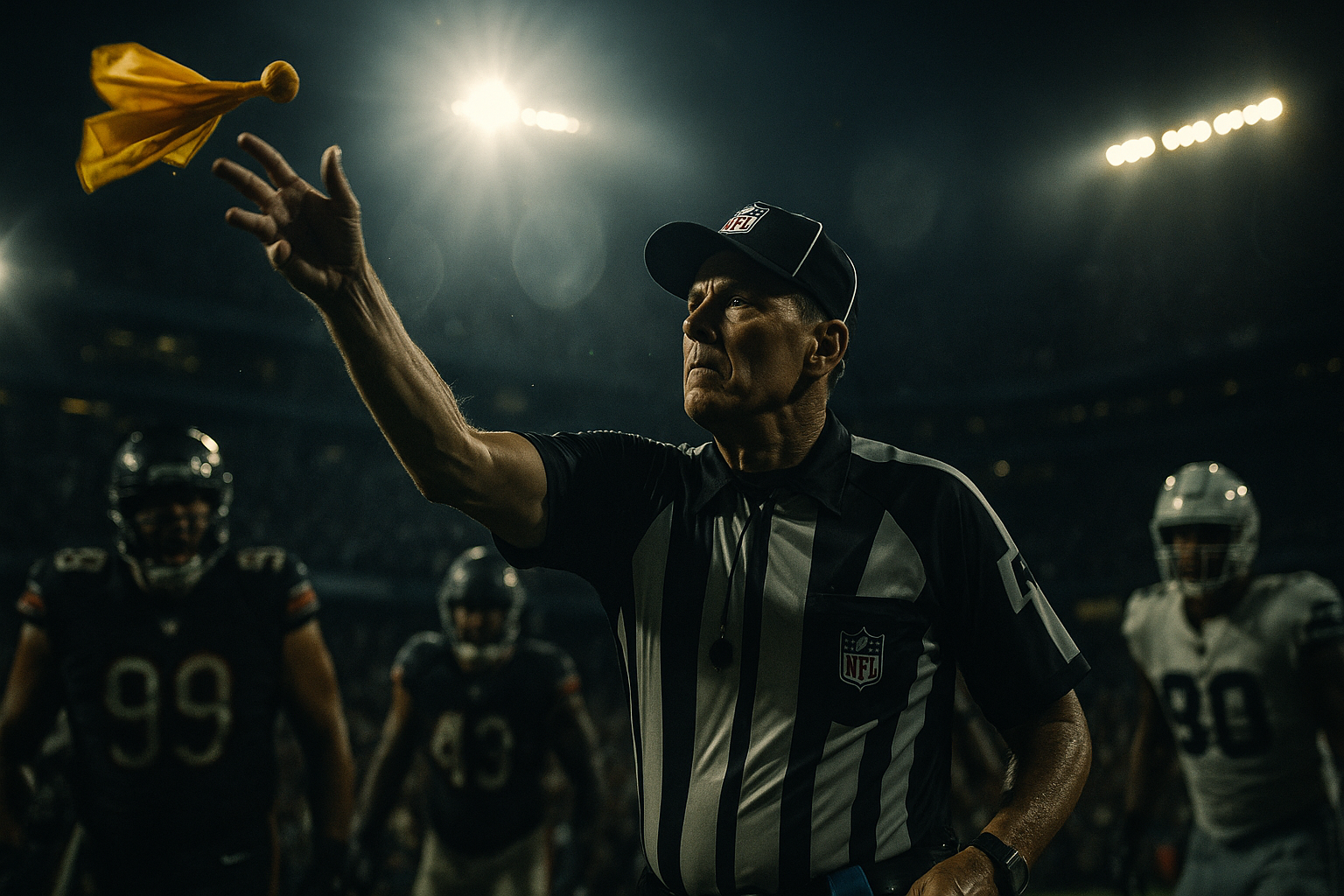
An LVSM investigation into how emotion, money, and bias shape calls and outcomes—backed by data, history, and sources.
By Michael Munerlyn — Las Vegas Sports Media | 2025 Every Sunday, millions of Americans invest their time, money, and emotion into a game they believe is fair. But in 2025, the NFL’s outcomes are being shaped by something far more slippery than talent or preparation: human bias amplified by emotion, monetized by betting, and protected by opacity. This investigation traces how officiating power, gambling partnerships, and technology collide—and what must change if the league wants fans to trust the scoreboard again. “You don’t need proof of corruption to have a crisis of confidence. When perception becomes profit, integrity becomes optional.” For decades, NFL fans have lived with a quiet, uneasy truth: the biggest variable in football isn’t always the players — it’s the officiating. Every Sunday, games that millions bet on, cheer for, and emotionally invest in are still decided by a small crew of men and women whose authority is absolute, but whose judgment is far from objective. We’ve been told it’s “the human element,” that referees make mistakes like anyone else. But the evidence — both scientific and historical — tells a deeper story. This isn’t just about human error. It’s about human bias. Referees, like the rest of us, bring their experiences, instincts, and unconscious prejudices onto the field. Under the bright lights, surrounded by roaring crowds and billion-dollar stakes, those biases don’t disappear — they sharpen. Studies from institutions like Roskilde University and Frontiers in Sports reveal that referees consistently display measurable bias — toward home teams, high-status players, and, yes, even along racial lines. One 2021 paper argued that professional sports organizations should test officials for implicit bias, because “referee decisions are not always as unbiased as they ideally should be; decisions seem to be biased for or against people of different race, gender, or height.” Another Frontiers in Sociology study found that in the NFL, Black players were flagged for holding more often than their white counterparts, even when accounting for position and performance variables. These weren’t random, once-in-a-while mistakes — they were statistical patterns. And that’s the key word: patterns. The science behind this is well-established. Cognitive researchers call it implicit bias — the unconscious associations we all carry that shape our split-second judgments. In a 2012 Journal of Experimental Social Psychology experiment, referees were shown to penalize Black athletes more harshly for post-score “celebration” behavior, reflecting cultural stereotypes about “arrogance” and “swagger.” That same mental mechanism plays out on Sundays when a big, mobile Black quarterback like Cam Newton took hit after hit — late, high, and uncalled. The pattern continues today with players like Lamar Jackson, who’ve absorbed countless blows both in the pocket and on the move, yet still rarely draw a flag. The referee doesn’t have to consciously think, He can handle it — the bias fires automatically. Years of societal conditioning whisper that these players are tougher, wilder, or harder to control. And so the whistle stays silent. By contrast, when a pocket passer with a certain media image takes a bump, empathy kicks in. The bias flips. The same contact is seen as roughing, dangerous, flag-worthy. When we zoom out, the trends are undeniable. Independent analyses like the 2023 Time2Play report found persistent disparities in penalty rates across teams — with some franchises averaging nearly two more flags per game over a decade-long span. University of Iowa data echoed this, showing that certain referees call significantly more penalties than others, and that “home-field advantage” extends to the officials themselves. It’s not luck — it’s behavior. And the NFL knows it. Officials are graded internally, but the system is opaque, the data private, and the accountability nonexistent. Unlike the players, their performance metrics never reach the public. The same league that can track a football’s rotation to the tenth of a degree has no public database tracking which referees consistently favor which teams. Referees don’t just decide games — they shape legacies. A questionable flag can change a playoff berth, an MVP race, or a contract extension. Careers rise and fall on these calls. Entire fan bases lose faith in the fairness of the game when they sense favoritism or inconsistency — and that distrust spreads fast. Because once bias is allowed to live unchallenged in the officiating booth, it infects the league’s integrity itself. The NFL markets itself as a meritocracy — a pure contest of preparation, strength, and skill. But how “pure” can the competition be when the rulebook bends differently depending on the name on the jersey, the color of the skin, or the size of the market? This isn’t a problem that will go away with new rules or better replay systems. It’s a cultural problem — one rooted in who holds power, who’s protected by perception, and who isn’t. Yes, referees are human. But that’s not an excuse — it’s the explanation. Human judgment is messy, emotional, and biased. In most workplaces, those flaws are checked by oversight, data, and accountability. In the NFL, they’re disguised as tradition. And as long as “the human element” remains a shield for systemic bias, fans and players alike will keep paying the price. Because this problem — this long-standing, league-protected inconsistency — isn’t an accident of humanity. It’s a reflection of it. Before we talk about football, we need to talk about basketball. Because the NBA — long before the NFL became America’s biggest betting stage — wrote the modern playbook on controlled officiating and narrative management. In 2007, the NBA’s worst nightmare broke wide open. Referee Tim Donaghy was indicted for betting on games he officiated, using inside information to influence point spreads and outcomes. It wasn’t just a rogue official caught gambling — it was a window into the system. Federal investigators discovered that Donaghy not only placed bets but manipulated calls to affect the outcome of those wagers. The FBI linked him to organized crime figures and illegal bookmakers. The scandal hit like a concussion across professional sports: if it could happen in the NBA, it could happen anywhere. What’s often forgotten is what Donaghy revealed after he was caught. In interviews and court testimony, he described an officiating culture shaped not just by error but by league-driven bias — where referees were implicitly encouraged to favor certain teams, players, and narratives for the “good of the game.” Star players were protected. Series were extended. Marketable matchups were prioritized. Donaghy claimed the NBA used officiating to “manage outcomes” — not fix them overtly, but nudge them through foul calls, no-calls, and game flow. It was a revelation the league desperately tried to contain, framing him as an outlier. But to anyone paying attention, it confirmed what fans had long suspected: the whistle was never neutral. Even before Donaghy’s downfall, data analysts had started to pick up strange statistical anomalies. A 2007 New York Times analysis found that home teams received 1.5 fewer fouls per game on average, and “superstar” players went to the free-throw line at disproportionate rates compared to others who drew similar contact. Subsequent studies reinforced those trends. A 2012 Journal of Sports Economics paper documented how referees were subconsciously swayed by crowd reactions, television coverage, and team status — a phenomenon known as status bias. When the lights burned brighter, the whistles got quieter for certain players. But there was another, more insidious bias lurking underneath: racial and physical perception bias. No example captures this better than Shaquille O’Neal. During his prime, Shaq was a physical anomaly — a 7’1”, 325-pound force who dominated defenders in ways the league had never seen. Yet despite enduring near-constant hacking, he rarely drew the fouls that smaller players did. Referees justified it with a kind of circular logic: “He’s so big, it’s hard to tell what’s a foul.” But what that really meant was, He’s so dominant, we’ve adjusted the rules for him. Shaq himself spoke about it often, saying, “I get fouled on every play. They just don’t call it.” Analysts called it “The Shaq Paradox” — the idea that being too strong made you less worthy of protection. This wasn’t officiating inconsistency; it was selective tolerance, and it sent a dangerous message that skill and physical power could be punished by perception. The bigger the athlete, the less empathy they received from the whistle. That same psychology still echoes today on football fields across America — where physicality, swagger, or the wrong kind of confidence can subconsciously mark certain athletes for harsher treatment. Contrast that with Michael Jordan. In the 1990s, the NBA built an empire on his name. Jordan wasn’t just the face of a franchise — he was the face of the league, its global brand, its TV ratings, and its marketing engine. As Jordan’s superstardom grew, so did the perception — and the reality — of “superstar calls.” Fouls that were no-calls for him became technicals for others. Referees gave Jordan room to express emotion, to challenge, to glide. And when the league needed him protected, he was. This wasn’t a conspiracy — it was an unspoken economic truth. The NBA understood that protecting Jordan was protecting the product. The more the league expanded internationally, the more it relied on maintaining the myth of invincibility around its chosen icons. When Jordan retired, those same “Jordan Rules” — both offensive and officiating — were gradually replaced by a new marketing direction that emphasized finesse, personality, and accessibility. The league’s officiating philosophy evolved not because of fairness — but because business demanded it. These patterns reveal something every league executive knows but rarely admits: officiating isn’t just about enforcing rules. It’s about managing perception. Who gets a foul, who gets protection, who’s allowed to show emotion — all of it shapes how fans, sponsors, and the media interpret the product. Referees, whether consciously or not, enforce the league’s cultural hierarchy. When the NBA shifted to promote faster play, higher scoring, and international appeal, officiating changed accordingly. Hand-checking was banned. Physicality was penalized. Stars were insulated. Not because the rules demanded it, but because the business model did. That’s how you humble players like Shaq, reshape eras around marketable icons like Jordan, and maintain control over narratives that drive revenue and ratings. What the NBA proved — painfully and publicly — is that officiating can be both a tool and a weapon. It can be manipulated, consciously or subconsciously, to build heroes and bury threats. To extend playoff series. To temper personalities. To humble those who challenge the system. And if it happened in the NBA — a league that, to this day, still wrestles with questions of officiating integrity — why would we ever assume the NFL is immune? The Donaghy scandal was more than a black eye for basketball; it was a warning label for all professional sports. Because once officiating becomes a tool of influence, it stops being about fairness — and starts being about control. “And control, in a multibillion-dollar ecosystem, is never an accident. It’s a strategy.” Once upon a time, the NFL treated gambling like a disease. Commissioners called it a threat to “the integrity of the game,” and players could be banned for life just for being associated with a bookmaker. But in 2025, the league doesn’t just coexist with gambling — it profits from it. It happened slowly, then all at once. In 2018, the Supreme Court overturned PASPA, the federal ban on sports betting, and the NFL’s public stance flipped almost overnight. By 2021, the league had signed exclusive deals with Caesars Entertainment, DraftKings, and FanDuel — partnerships worth over $1 billion collectively. By 2025, almost every stadium features sportsbook ads, betting lounges, and live odds flashing across jumbo screens while the game unfolds. The NFL now earns hundreds of millions annually from betting sponsorships, data licensing, and partnerships with casino brands. It sells official league data to sportsbooks in real time, ensuring that every yard, flag, and timeout can be instantly wagered on. This isn’t the NFL protecting the game — it’s the NFL monetizing the risk. The league will tell you these partnerships are “regulated,” that integrity safeguards exist, that “no one can influence outcomes.” But how do you separate oversight from ownership when the same institutions promoting bets also control the product being bet on? The NFL profits from engagement. The more fans bet, the more the league’s value grows. But betting thrives on volatility — on controversy, uncertainty, and perception. And nothing fuels engagement like a blown call or a questionable flag in the fourth quarter. In other words, chaos has become good business. That’s the quiet paradox the NFL doesn’t want to talk about: The league makes money off the very ambiguity it claims to be eliminating. Every disputed call trends. Every viral replay boosts viewership. Every controversial outcome drives bettors to chase redemption next Sunday. You don’t have to believe the games are fixed to see the problem. You just have to understand incentive. By conservative estimates, Americans will wager more than $150 billion on sports in 2025. The legal market represents only part of that — another $60–80 billion still flows through offshore books and underground operations. Organized crime hasn’t vanished; it’s evolved. Today’s mob doesn’t need to rig games with threats — it can influence markets quietly through data leaks, player connections, or low-level officials. And when billions move with every field goal or holding call, the margin for manipulation shrinks to a single whistle. The 2007 Donaghy scandal showed what one compromised referee could do to basketball’s credibility. The NFL has 122 active officials, each with access to game scripts, injury updates, and officiating tendencies — information that would be worth a fortune in the right hands. And yet, there is no transparent, independent system publicly auditing referee performance or betting correlations. The league polices itself. That’s not accountability — that’s an illusion of it. When players like Calvin Ridley and Isaiah Rodgers were suspended for betting on games, the NFL moved swiftly and publicly. But when referees miss blatant calls that swing outcomes — in games with hundreds of millions in betting volume — there are no suspensions, no public statements, no oversight committees. It’s punishment for the powerless, protection for the profitable. And the hypocrisy cuts deeper: The same league that bans players for $1,000 parlays is simultaneously collecting licensing fees from the betting companies taking those bets. The NFL’s integrity policy reads like scripture, but its business model reads like a casino ledger. The league’s official integrity program is built on partnerships with “independent monitors” — private firms paid by the very organizations they’re auditing. These firms track irregular betting patterns and report potential red flags. But their data isn’t public. Their findings aren’t transparent. Their authority depends on the same system they’re meant to regulate. That’s not independence — that’s insulation. And the NFL’s biggest defense — “there’s no evidence of game manipulation” — misses the point. You don’t need proof of corruption to have a crisis of confidence. When the fans believe outcomes are being influenced, whether by bias, business, or the balance sheet, the damage to integrity is already done. Perception becomes reality — especially when perception is all the public has left. In an age when AI can track player positioning, crowd noise, and real-time decision latency, the technology already exists to monitor officiating with perfect objectivity. Algorithms could instantly flag inconsistencies — such as how often a particular referee calls holding penalties against one team versus another, or whether late-game flags favor home teams disproportionately. But that technology isn’t being used to protect the game. It’s being used to profit from it. The same real-time data that could expose bias is being sold to sportsbooks for micro-betting markets — “Will the next play be a pass or a run?” “Will there be a penalty on this drive?” The infrastructure for integrity already exists; it’s just pointed in the wrong direction. The truth is, the NFL doesn’t need to fix games to benefit from how they’re managed. It only needs to maintain a system where ambiguity and authority coexist. Referees make subjective calls. Fans debate. Bettors react. Networks replay. Engagement spikes. Revenue climbs. And the league stays in control of both the narrative and the numbers. It’s not conspiracy — it’s capitalism. And as long as billions are being made on “maybe,” the NFL has every incentive to keep it that way. Integrity isn’t a slogan; it’s a structure. Once that structure collapses, it doesn’t matter how many partnerships the league signs or how many AI systems it claims to use. The NFL’s brand has become inseparable from betting — and that means its officiating isn’t just a sporting issue anymore. It’s a financial instrument, a variable in a trillion-dollar marketplace of perception, emotion, and probability. Until officiating is independently audited — with public transparency and technological accountability — the NFL will remain caught between two masters: the game, and the money. And history tells us which one usually wins. We're living in the most technologically advanced era in sports history. And yet — in 2025 — games are still being decided by a group of humans guessing in real time. Artificial intelligence is already transforming officiating around the world. The technology exists. It’s tested. It’s trusted. So why hasn’t the league done it? Because ambiguity is profitable. The NFL thrives on tension and controversy. The gray area between “right” and “wrong” keeps fans arguing, networks replaying, and social media inflamed. It’s part of the entertainment cycle now. Integrity doesn’t trend. Controversy does. What makes the league’s inaction harder to justify is that AI already runs much of the game’s infrastructure. Every play is measured, cataloged, and sold in data packages to gambling partners who rely on it to adjust live odds. But the same AI that’s used to fuel the betting economy could also be used to protect the sport’s integrity. That data could expose bias, flag potential manipulation, and hold officials accountable. Imagine an AI-based officiating transparency dashboard — a live public record showing how every official calls penalties across all teams, positions, and timeframes. It would be revolutionary. Transparency removes plausible deniability. As long as decisions appear subjective, the league can hide behind its favorite phrase: “judgment call.” Deep down, the NFL’s fear isn’t that AI will get calls wrong — it’s that AI will prove how often humans have been getting them wrong all along. It’s easier — and more profitable — to keep pretending that human fallibility is part of the charm. There is a path toward integrity if the league chooses to take it. Fans deserve to know that the technology powerful enough to move billions in bets is also being used to protect the integrity of the sport they love. The NFL likes to call officiating “an art, not a science.” But that explanation, noble as it sounds, hides something deeper and far more dangerous: Every NFL referee stands inside an emotional hurricane — 70,000 screaming fans, roaring stadium acoustics, national TV lights, players pleading, coaches shouting, and millions watching from home ready to dissect every move on social media. Cognitive psychology tells us that in high-stress, high-stakes environments, humans default to pattern recognition and emotional impulse — the mental shortcuts known as heuristics. In 2019, a Journal of Sports Behavior study on professional soccer referees found that crowd noise directly affected call frequency — with officials subconsciously favoring home teams by up to 15 percent more fouls called against visitors. Now imagine that dynamic amplified by the NFL — the largest live spectator sport in America. If emotion drives calls, then the league profits from emotion. Studies from Frontiers in Psychology and ESPN’s analytics division have repeatedly shown that home teams in the NFL benefit from fewer penalties in critical moments, particularly late in close games. “You hear 60,000 people react, and you second-guess what you saw. The emotion gets in your ear before the replay does.” That emotional noise becomes part of the product — the same “human element” the league uses to sell drama and uncertainty. Emotion doesn’t just run from the crowd to the referee; it flows between referees and players too. When players protest calls too passionately, display too much swagger, or challenge authority too directly, referees subconsciously respond by reasserting dominance — through technicals, personal fouls, or even subtle leniency against opponents. This phenomenon is especially visible when cultural expression meets institutional discomfort. In those moments, emotion and ego merge — and justice takes a backseat to control. Psychologists have long studied the empathy gap in officiating — the phenomenon where referees unconsciously empathize more with players who look, act, or communicate like them. NFL officials, still overwhelmingly white and male, often share more cultural proximity with certain players than others. A borderline roughing call against a traditional pocket passer might trigger instinctive concern — “protect the quarterback.” The league leans on this humanity as both shield and scapegoat. Emotion becomes the perfect defense against accountability. It shows that the system isn’t broken; it’s built on subjectivity. Emotion is currency in modern sports. The league understands that emotion drives engagement far more than objectivity ever could. By preserving emotional officiating, the NFL preserves volatility — and volatility feeds the machine. No one wants to strip the game of its passion or its human spirit. Emotion in officiating isn’t authenticity; it’s liability. If AI can track penalties without feeling, and referees can be monitored for consistency without punishment, then the “human element” is no longer a virtue — it’s a vulnerability. In the modern NFL, every flag thrown and every one not thrown moves money. With legalized sports betting woven into nearly every broadcast and mobile app, the NFL has become the epicenter of a global gambling economy worth hundreds of billions of dollars. And the deeper you go, the more one truth becomes impossible to ignore: In 2025, the sports betting industry is projected to generate over $200 billion in legal wagers in the United States alone — a figure that triples when global markets and illegal operations are included. That’s where officiating becomes the hinge. The league’s official data feeds — the same live telemetry used to update fantasy scores and odds — are sold to sportsbooks for premium access. According to recent Interpol and UNODC reports, illegal sports betting generates over $1 trillion globally each year. Football — particularly the NFL — has become a major frontier for these operations because of its complexity and volatility. For organized crime, that’s not chaos — that’s opportunity. Every controversial flag, every questionable call, every emotional overreaction from a crowd doesn’t just affect fans — it affects markets. In effect, every officiating inconsistency becomes a data point — a way to anticipate how humans (fans and bookmakers alike) will react. “You don’t need to fix games anymore. You just need to predict how chaos will be interpreted.” The image of organized crime manipulating sports used to mean shady figures slipping envelopes to referees in back rooms. Criminal networks now use AI-enhanced models to identify referees whose patterns create profitable volatility. It’s not direct manipulation; it’s exploitation of predictability. The NFL publicly insists that its integrity monitoring partnerships with data firms like Genius Sports and Sportradar protect the league from such exploitation. No independent third-party oversight exists to investigate potential conflicts between officiating anomalies and betting line movement. When money flows this freely, corruption doesn’t need conspiracy — it only needs access. And because human bias and emotion are built into the officiating process, no fix ever looks suspicious. The emotional volatility of referees — the same biases we explored earlier — isn’t just a flaw; it’s a commodity. What begins as emotional manipulation on the field ends as financial manipulation off it. The league’s refusal to open officiating data or allow independent audits doesn’t just protect its image; it protects the system. But make no mistake: when so much unregulated money moves through emotional outcomes, integrity isn’t a virtue — it’s a liability. This isn’t about a single scandal waiting to happen. The emotional officiating, the selective enforcement, the opaque data — all of it forms the perfect storm where sport, business, and organized crime quietly overlap. “The danger isn’t that the game’s being fixed. The danger is that nobody would notice if it was.” That’s the bigger picture. The NFL’s problems aren’t unsolvable. For decades, the league has hidden behind slogans like “the human element” and “protecting the integrity of the game.” If the NFL truly believes in fairness, then it’s time to prove it — with action, transparency, and technology. Right now, the NFL’s officiating department investigates itself. A true integrity system begins with independence. No referee, crew, or league executive should have the ability to bury accountability behind closed doors. Every Sunday, millions of data points flow through NFL servers: GPS tracking, play-by-play telemetry, biometric performance, and officiating logs. Imagine a public referee dashboard — a digital portal where anyone can see: That level of visibility would do more for integrity than a thousand press conferences. And if certain officials can’t stand up to that level of scrutiny, they shouldn’t be officiating at the highest level of sport. Artificial intelligence shouldn’t replace referees — it should reveal their blind spots. Here’s how: These tools already exist in other global sports. The phrase “judgment call” should no longer be a shield for inconsistency — it should be a trigger for review. Every referee in the NFL is graded after each game — a process the league keeps secret. Referees are public figures in a public enterprise. Their performance should be held to public standards. If players are fined for missing media interviews, why aren’t referees publicly accountable for missed calls that cost franchises millions? The NFL cannot continue to profit from betting partnerships while claiming to protect integrity. This isn’t about criminalizing betting — it’s about deconflicting interests. Technology can fix errors, but only culture can fix bias. That means: Fairness isn’t achieved by algorithms alone; it’s achieved by empathy guided by evidence. Football belongs to the fans — not to corporate sponsors, data brokers, or casino interests. Create a Fan Integrity Council, composed of supporters from across the league’s 32 teams, empowered to review transparency reports, propose reforms, and communicate directly with the Independent Officiating Review Board. True accountability doesn’t flow top-down; it flows from the ground up. These reforms aren’t radical — they’re necessary. The technology is ready. The choice is no longer between human or machine, old school or innovation. Every Sunday, millions of Americans sit down for the same ritual — a sacred three-hour escape wrapped in helmets, colors, and hope. But what happens when the truth becomes negotiable? That’s where we are in 2025. The NFL tells us to “trust the shield.” We’ve watched games swing on calls that defy explanation. But that’s not football. That’s theater. The NFL is a billion-dollar machine powered by emotion — and emotion requires belief. That belief is the league’s most valuable currency — more than sponsorships, more than TV deals, more than betting contracts. Because every time a flag decides a season, every time the league hides officiating data, every time profit takes precedence over principle, a piece of that trust dies. Fans don’t demand perfection. We demand honesty. Accountability isn’t an attack on the game. It’s the only thing that can save it. This story isn’t just about referees, algorithms, or betting apps. Football has always mirrored America: flawed, passionate, diverse, and determined. The league has mastered the art of distraction — highlight reels, halftime shows, and heartwarming commercials — while the system beneath remains opaque. The fans are the true owners of this game. We don’t want sanitized entertainment. We want truth. The fixes are there — independent oversight, AI auditing, public data transparency, referee accountability, and ethical separation from betting profits. The question that remains isn’t can the NFL change — it’s will it? If the answer is no, then this game we love — this Sunday tradition that binds families and generations — will become something else entirely: This isn’t just journalism. It’s a call to conscience — for fans, players, and anyone who still believes in the sanctity of sport. The time for excuses is over. Maybe someday we’ll look back on this era as the wake-up call — the moment football faced itself in the mirror and decided to evolve. Because at its core, football isn’t about money, power, or algorithms.THE HIDDEN FLAGS: How Emotion, Money, and Bias Are Rewriting the Game

1. The Problem That Won’t Go Away
The Bias Beneath the Whistle

Bias isn’t chaos — it’s consistency in the wrong direction. It’s why one player can be hit late and the flag stays in the pocket, while another gets a fifteen-yard penalty for a tap on the helmet. It’s why some teams — often those with prestige, popularity, or high ratings — benefit from “momentum calls,” while others are punished for the same actions in reverse.What Psychology Tells Us
What we call “a judgment call” in the NFL is often just bias wearing stripes.The Data Doesn’t Lie
That’s not by accident. It’s by design.The Deeper Cost of Bias
The Real Human Element
2. The Precedent: What the NBA Taught Us

The Donaghy Scandal: When the Whistle Turned Criminal
Patterns Hidden in Plain Sight
The Shaq Standard: When Strength Became a Penalty
The Jordan Effect: When the League Chooses Its Heroes
The Politics of the Whistle
From Hardwood to Gridiron
3. The Money Game — NFL and Sports Betting in 2025

From Taboo to Business Model
A Conflict of Interest Hiding in Plain Sight
Billions on the Line — and in the Shadows
The League’s Double Standard
The Mirage of Integrity
AI, Analytics, and the Accountability Gap
The League’s Silent Agreement
The Real Stakes
4. THE AI FACTOR — NO MORE EXCUSES

Every yard, every hit, every rotation of the football is captured by high-speed cameras, RFID chips, satellite tracking, and machine-learning analytics.
The NFL knows where every player is within inches and when every whistle blows down to the millisecond.
That’s not because technology can’t do better.
It’s because the league doesn’t want it to.Technology Can See What Humans Can’t
If the NFL implemented similar systems — a combination of AI-driven replay analysis, sensor-based penalty detection, and objective data auditing — it could remove nearly all officiating subjectivity.
A late hit, a pass interference, a line-of-scrimmage foul — all could be flagged automatically and reviewed instantly.
No emotion. No bias. No “gut feeling.”The Business of Ambiguity
Every blown call fuels debate. Debate fuels engagement. Engagement fuels betting.
A perfectly fair game would be great for ethics — but terrible for business.
If AI eliminated that ambiguity — if officiating were suddenly beyond debate — the drama would shrink, and with it, the endless cycle of attention that drives clicks, commentary, and wagers.
AI Already Works — But Not for Integrity
The NFL uses machine learning for injury analytics, player tracking, and betting data licensing.
The league even markets this as a triumph of innovation.
An algorithm trained on years of penalty data could identify anomalies in seconds:
But instead of releasing it to the public, the NFL sells it to the highest bidder.The Technology They Don’t Want You to See
Imagine fans being able to see bias patterns unfold in real time.
It would also be a nightmare for the league’s narrative control.
And plausible deniability is what allows the NFL to maintain authority without accountability.
But once the data shows those judgments aren’t evenly distributed, the illusion of fairness collapses.The Fear of the Mirror
An automated officiating system would make bias quantifiable.
It would show, in black and white, how certain players, teams, or markets have benefited from the current structure.
And once that truth is out, there’s no putting it back.The Path Forward
It starts with independent AI auditing — algorithms trained not by the NFL, but by third-party ethics and data organizations.
It means publishing referee performance metrics after every game.
It means using AI not just for fantasy stats and gambling insights, but for fairness.If AI can track every step a player takes, it can also track every flag an official throws — and why.
And in 2025, there are no more excuses.5. THE HUMAN ELEMENT — WHEN EMOTION SHAPES OUTCOMES

It’s their favorite defense whenever the flags fly unevenly or the replay leaves fans furious.
They remind us that referees are human — emotional, instinctive, imperfect — and that’s “part of the game.”
Emotion doesn’t just influence officiating — it directs it.The Anatomy of an Emotional Call
Under those conditions, it’s not reason that rules; it’s pressure.
That means decisions aren’t purely objective; they’re guided by what feels right in the moment.
A 2022 analysis of NBA data reached the same conclusion: when noise levels rose, referees’ judgment shifted measurably toward the crowd’s desires.
When 70,000 people gasp at contact or boo a clean hit, that energy becomes invisible pressure.
The whistle is no longer neutral; it’s reactive.
And the league knows it.Crowd Bias: The League’s Quiet Advantage
Home-field advantage isn’t just noise and momentum — it’s officiating leverage.
Officials may not consciously choose sides, but their instincts — shaped by the roar, the rhythm, the energy — do it for them.
Because when emotions influence the whistle, every fan feels like they’re part of the game — even when they’re unknowingly tilting it.Referee Power Dynamics: The Psychology of Control
Sports psychologists call it authority assertion bias — the instinct to reestablish control when it feels threatened.
Outspoken or flamboyant players — particularly Black athletes — often trigger harsher reactions from officials who mistake confidence for defiance.
It’s the emotional echo of the same bias that once allowed Cam Newton to take uncalled hits, or Shaquille O’Neal to be fouled relentlessly without recourse.The Empathy Gap
It’s not racism in the overt sense; it’s familiarity bias — the quiet comfort of recognizing yourself in another person.
That doesn’t make them villains — it makes them human.
But when empathy aligns unevenly on the field, fairness disappears in real time.
The same hit on a mobile Black quarterback might instead evoke admiration — “he’s tough, he can handle it.”
Both thoughts are human. Both are emotional. And both change the outcome of the game.Emotion as a Shield
Whenever controversy erupts, the NFL hides behind the same language: “Referees are human; mistakes happen.”
It’s a convenient truth that stops the conversation before it threatens the system.
You can’t audit a feeling.
You can’t quantify instinct.
And as long as calls can be explained away by “judgment,” the league never has to confront the biases and emotional conditioning embedded in its officiating culture.Emotion isn’t an excuse — it’s evidence.
The Emotional Economy
Networks sell it. Sportsbooks exploit it. The NFL packages it into every storyline — redemption arcs, rivalries, heartbreaks.
A fan enraged by a missed call is still a fan who tunes in next week “to see what happens.”
So when they tell us “referees are human,” they’re really saying “referees are useful.”
Their emotions keep the outcome unpredictable, the debate alive, and the ratings high.When Humanity Needs a Check
But emotion should belong to the players and the fans — not the officiating crew tasked with enforcing fairness.
It bends the rules, biases outcomes, and undermines trust.Until the league separates emotion from enforcement, the integrity of the game will remain at risk.
Because as long as emotion drives the whistle, the scoreboard will never tell the whole story.6. THE BIGGER PICTURE — BILLIONS AND ORGANIZED CRIME

That’s not hyperbole — that’s economics.
But what most fans don’t realize is that this system doesn’t stop at Vegas or DraftKings.
It stretches far beyond — into offshore networks, crypto-driven betting exchanges, and the shadow pipelines of organized crime.
Emotionally influenced officiating is the perfect cover for financial manipulation.The Legal Face of an Unregulated Empire
The NFL sits at the top of that pyramid, with more action than every other major American sport combined.
Each game can attract tens of millions of dollars in live wagers — not just on outcomes, but on micro-bets: who scores first, when the next flag drops, whether a drive ends in a punt.
One penalty in the final two minutes can swing entire betting markets.
It’s all legal, transparent on the surface, and heavily promoted through advertisements that blur the line between fandom and finance.
But beneath that surface, another market is thriving — one that doesn’t pay taxes, follow regulations, or answer to any commission.The Shadow Market
That figure dwarfs the legal market, and it’s powered by everything the regulated system can’t control: offshore accounts, anonymous crypto transactions, and manipulation of insider information.
Dozens of players, hundreds of variables, and a human officiating system that can turn probabilities into profit with a single subjective decision.
You don’t have to bribe players or rig outcomes anymore.
You just need to exploit perception.The Perception Game
When a referee’s call swings momentum, live-betting odds shift instantly.
Betting syndicates track those swings and exploit them using automated algorithms that bet against emotional overcorrections by the public.
And when the NFL allows emotion to shape officiating, it’s not just influencing the scoreboard — it’s fueling a multi-billion-dollar perception economy.
Organized Crime 2.0
That era is mostly gone.
Today’s corruption is digital — decentralized, data-driven, and almost invisible.
They monitor betting volume spikes following controversial officiating crews or prime-time matchups.
When the data suggests vulnerability — a ref known for late flags, emotional control issues, or specific team biases — the smart money moves accordingly.
And the NFL’s emotional, unaccountable officiating culture gives these networks everything they need.The League’s Blind Spot — Or Its Buffer
But those same companies also provide betting data feeds to sportsbooks and casinos.
That’s like having the same security guard watch both the vault and the robber.
The NFL’s integrity unit answers to the league itself.
And as long as there’s no outside audit, suspicion is managed, not eliminated.
The Psychology of Corruption
A single official with gambling debt, a friend with insider data, or a subtle lean toward “home advantage” can ripple through global betting markets.
A missed holding call can be chalked up to “judgment.”
A questionable pass interference becomes “a tough call in real time.”
Subjectivity is the perfect camouflage.The system’s brilliance lies in its plausible deniability.
When Emotion Meets Economics
The market feeds on unpredictability.
Bettors chase redemption.
Fans debate morality.
Networks amplify controversy.
And organized crime thrives in the noise between fairness and fury.
Every controversial Sunday becomes a gold rush — legal or otherwise.The Cost of Silence
As long as the public believes corruption is a relic of the past, the machine keeps running — fueled by emotion, insulated by subjectivity, and bankrolled by billions.
And in that environment, organized crime doesn’t need to infiltrate the game.
The game is already built to accommodate it.The Real Risk
It’s about a system designed to look just accountable enough to function — while remaining flexible enough to profit from chaos.
And until the NFL chooses transparency over profit, emotion over automation, and oversight over optics — the shadow will always be bigger than the field.7. THE CALL FOR REFORM — BUILDING A TRANSPARENT FUTURE

They’re unacknowledged.
But integrity isn’t a brand; it’s a behavior.
And behaviors can change — if there’s the will to change them.1. Independent Oversight — Take the Power Out of Park Avenue
When a controversial call decides a playoff berth or a Super Bowl, the same organization that profits from the outcome also reviews the evidence.
That’s not oversight; that’s theater.
The league must establish an Independent Officiating Review Board (IORB) — a third-party body composed of former officials, sports law experts, technologists, and ethics auditors.
Public trust can’t be managed from inside the same building that cashes the checks.2. Data Transparency — Let the Numbers Speak
But the only people who ever see that officiating data are those paid by the league.
It’s time to end that monopoly on truth.
Transparency isn’t the enemy of football; it’s its insurance policy.
When fans can see the numbers for themselves, they stop assuming conspiracy — and start trusting accountability.3. AI-Assisted Officiating — The End of the “Judgment Call”
The future of fair play lies in augmented officiating: blending human experience with machine precision.
They’re not speculative — they’re proven.
If the league can license its AI data to sportsbooks, it can certainly use the same technology to protect the game itself.
4. Public Accountability — No More Hidden Grades
Those evaluations determine postseason assignments, promotions, and salaries.
But fans never see the results.
That secrecy breeds distrust.
Publish the grades.
Disclose the errors.
Reward excellence openly, and discipline negligence transparently.
The same spotlight that shines on athletes should shine on officials — equally, consistently, and without exception.5. Ethical Firewalls — Separate the Game from the Gamble
It’s time for a hard firewall between officiating operations and betting data divisions.
Integrity can’t coexist with incentive.
The NFL must decide what it values more: the purity of its sport or the profits of its partnerships.
If it chooses both, it risks losing both.6. Cultural Reform — Change the Whistle, Change the World
The league must confront the emotional and racial dynamics still woven into officiating.
When referees reflect the diversity of the athletes they officiate, they bring balance not just to the field — but to the culture of the game itself.7. Fan Oversight — Restoring the Public’s Role
It’s time to give fans a seat at the table.
When the people who love the game most have a voice in how it’s protected, the system begins to heal.A Blueprint for Credibility
AI oversight, public data, independent review, ethical separation, cultural training, and fan inclusion — together, they form a structure strong enough to withstand both human bias and corporate temptation.
The public is ready.
The question is whether the league is.
And if the NFL truly believes it’s “ nothing bigger than the game,” then it’s time to prove it by protecting the one thing bigger than money — trust.
The choice is between credibility and collapse.8. THE FINAL WHISTLE — THE FANS DESERVE BETTER

Football isn’t just a sport here. It’s a story we tell ourselves about effort, grit, and fairness — the idea that if you fight hard enough, play clean enough, and believe deep enough, the outcome will reflect the truth.
What happens when fairness itself becomes a marketing slogan?
A game once defined by heart is now shadowed by headlines, statistics, and suspicion.The Great Disconnect
But the shield no longer represents protection — it represents profit.
The referees are human, the rules are fluid, and the outcomes are increasingly entangled in a web of data feeds, gambling odds, and broadcast deals.
We’ve seen quarterbacks get blasted after the whistle with no flag — while others get brushed, or sometimes not even touched, and draw a late-hit penalty. We’ve watched defenders punished for invisible contact and receivers make impossible grabs that are somehow ruled incomplete. Think back to the Cowboys–Packers playoff game — the infamous Dez Bryant “no catch.” And we’ve seen playoff dreams vanish under what the league later shrugs off as “a judgment call.”
And through it all, we’re told to accept it — because “that’s football.”
A Game of Trust, Not Just Touchdowns
Belief that what we’re seeing is real.
Belief that what’s fair will prevail.
Belief that the scoreboard reflects merit, not manipulation.
And it’s running out.
Not all at once — but inch by inch, whistle by whistle.The Heartbeat of Accountability
We don’t expect referees to be robots — we expect them to be accountable.
We don’t expect the league to control every outcome — we expect it to stop profiting from the confusion that clouds them.
When technology can remove bias but isn’t used, when officials are graded but not scrutinized, when billions move on outcomes no one can verify — the game’s foundation cracks.
And when that happens, football stops being sport.
It becomes theater.
And the fans become props.The Hidden Cost
It’s about a cultural betrayal — the quiet erosion of fairness in exchange for entertainment value.
But just like the country it reflects, the game is now wrestling with its own morality.When money becomes god, integrity becomes optional.
And when emotion becomes business, honesty becomes risk.
But fans are smarter than ever.
We see the patterns. We track the trends. We know when something isn’t right.
And silence, at this point, is complicity.The Real Stakeholders
Not the executives, not the sportsbooks, not the broadcast networks.
The people who buy the jerseys, teach their kids the plays, and live and die by the schedule — we are the soul of football.
We don’t need perfection. We need transparency.
And if the NFL refuses to protect that, then it’s up to the people who built the culture around it to demand it.The Last Call
The technology exists. The willpower doesn’t.
Will it sacrifice short-term profit for long-term credibility?
Will it embrace technology not just to track players, but to protect them?
Will it treat its fans as stakeholders, not just customers?
A spectacle of manipulation disguised as competition.Our Call to Action
Because the truth is simple:
If fairness can’t survive in football — the most-watched, most-funded, most-loved game in America — where can it survive?
The technology is ready.
The evidence is clear.
And the fans deserve better.Epilogue: The Game We Could Have

Maybe we’ll see an NFL that finally values transparency over theatrics.
An NFL where AI protects players, not profits.
An NFL where fans don’t question the fairness of what they love.
It’s about the pursuit of truth — inch by inch, yard by yard.
And in that pursuit, the final whistle should never sound shallow.
It should echo with justice.